



“I’m a backend developer”—that’s what Sanya said for years
There’s a phrase we heard Sanya say over and over again for years on our team: “I’m a backend developer.” He didn’t say it out of modesty, but out of sincerity. Database structure, business logic, integrations—that’s where he’s in his element, and we’re happy to assign those tasks to him.
Front-end development, on the other hand, has always intimidated him a little. Not the implementation itself. If someone presents him with a design, he’ll code it. The problem has always been the blank canvas. As he puts it: imagination isn’t his strongest suit, and building a well-functioning system is a very different thing from deciding what kind of feeling a page should evoke. That’s exactly why he likes it when clients come to him with specific ideas.
The Task: One Place, Two Atmospheres
That’s exactly what happened recently. We were asked to create a website for an elegant venue—and the venue itself presented the most exciting challenge.
In the morning and early afternoon, it operates as a breakfast and brunch spot: leisurely mornings, fresh dishes, and serious coffee. On weekend evenings, however, it transforms into an elegant rooftop cocktail bar: sunsets and cocktails overlooking the city.
Two completely different worlds, under one brand name. The website had to reflect both moods while remaining cohesive—not a patchwork of two distinct styles, but a single place with two sides.
We were lucky: the client has excellent taste, so he was able to provide clear guidelines. That’s half the battle in a project like this.
Division of Labor
Sanya is a whiz at designing data storage structures—that’s where he started. This is the area where he’s always been strong: structure, logic, and data modeling.
However, he entrusted the implementation of the design to the AI. But not by simply saying, “Make something pretty”—rather, he used the client’s guidelines as a foundation and closely guided the AI’s work in line with them throughout the process. She set the direction, the boundaries, and the references, and with each iteration, she steered it back to where it belonged according to the site’s character. This way, the AI didn’t work in her place, but added the layer that she would have found harder to bring out on her own.
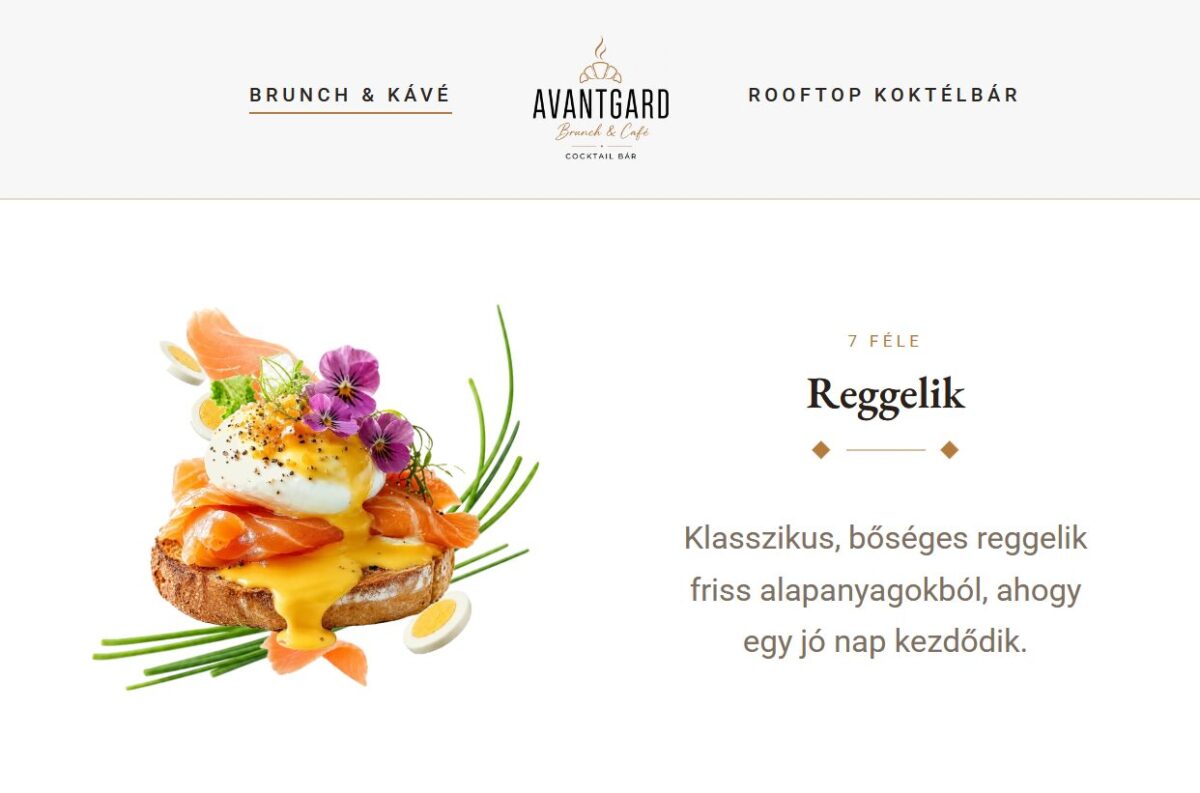
The result was an extremely elegant, responsive, and dynamic website. Sanya’s favorite feature is the one where the ingredients pop up from behind the category images—exactly the kind of small, playful detail that makes a site memorable.
Check it out: avantgardcafe.hu
The Takeaway
There’s no area where AI can’t help you—especially not where you feel you’re weakest.
Sanya used to define herself strictly as a “backend” developer. Today, she confidently takes on frontend work as well, because she feels she can create unique and beautiful websites even from less precise client requirements.
It’s not that AI taught him how to design. What happened was that the wall that had previously divided his work into two parts came down.
What kind of atmosphere do you want to convey on your website? Tell us, and we’ll make it happen.