



A client of ours already ran a successful store with an approved Merchant Center account and active Shopping ads. When they launched a second site, we set up a new Merchant Center account the same way. Products approved, feed clean, no warnings — until the day we launched the first campaign. Within hours, the account was suspended for misrepresentation.
If you’ve dealt with this suspension, you know the problem: Google doesn’t tell you what’s wrong. The misrepresentation policy is deliberately vague, there’s no specific error to fix, and support gives you the same policy page you’ve already read ten times.
What actually triggered the suspension
We audited everything and found three factors that, stacked together, made the account look suspicious to Google’s automated systems.
1. A brand-new site with thin trust signals
The store was only weeks old. Few indexed pages, no review history, minimal content beyond the product catalog. On its own, this is survivable — every store starts somewhere. Combined with the other factors, it wasn’t.
2. A cross-border setup
The company is registered in Slovakia and sells to customers in Germany. This is completely legal and common in the EU. But to an algorithm, a mismatch between the company’s country, the domain, and the target market is a classic misrepresentation pattern. Google can’t tell a legitimate cross-border business from a fake storefront unless you prove it.
3. A brand name with a hidden past
This was the one we didn’t see coming. Our client had acquired an existing company, and the brand name had operated before under a similar domain — with a pile of bad reviews on Trustpilot and Google that we knew nothing about. The site was new, but Google’s systems remembered the brand. We had inherited a reputation problem invisible from inside the business.
What got the account re-approved
We couldn’t erase the brand’s history, so we set out to outweigh it with new, verifiable trust signals.
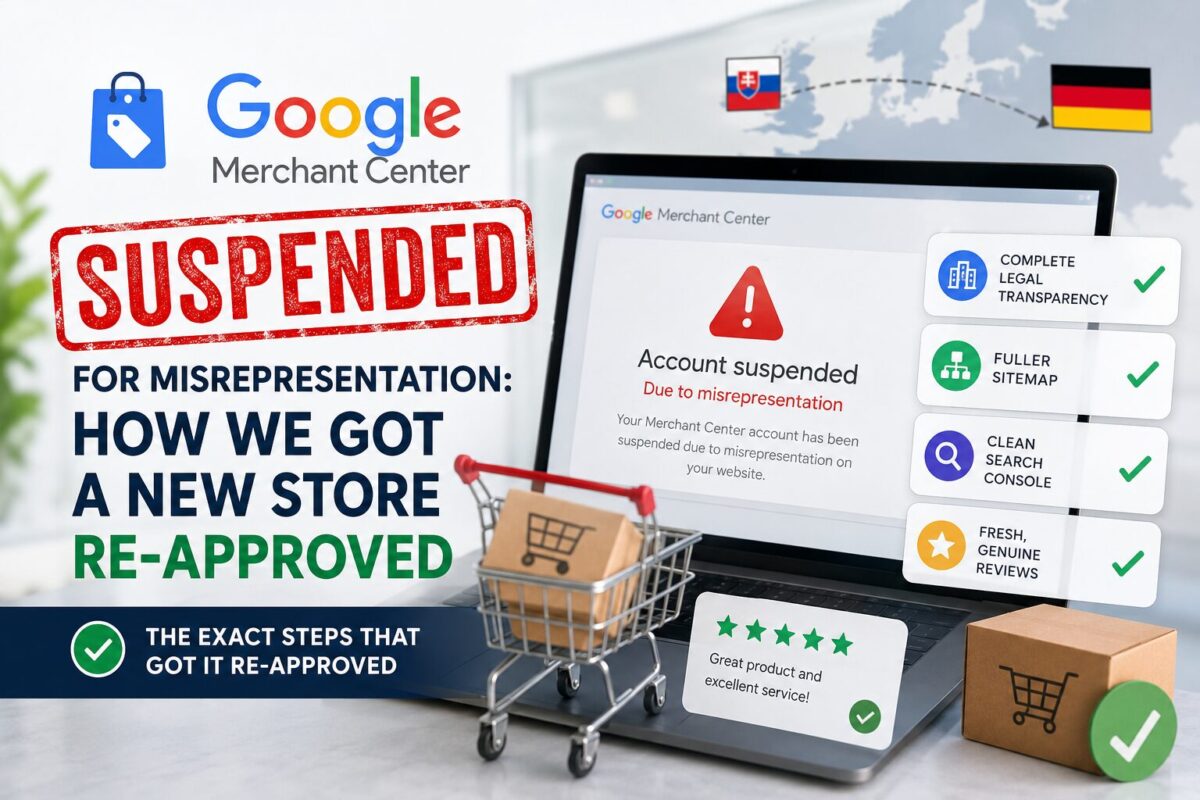
Complete legal transparency. We rebuilt the contact page with the full company details: legal name, registered address, company registration number, and real contact people. For cross-border sellers this is non-negotiable — Google has to be able to verify who is behind the store.
A fuller sitemap. We expanded the sitemap so Google could crawl the entire site — about pages, policies, content — not just a thin product storefront.
A clean Search Console. We resolved every issue in Search Console so nothing technical undermined the site’s credibility.
Fresh, genuine reviews. We started actively collecting reviews from real customers. This was the turning point. Once recent, positive signals from real buyers started accumulating, Google re-reviewed the account in a different light — and approved it. The ads have been running without issues since.
What to take from this
Misrepresentation suspensions are rarely about your products. They’re about whether Google trusts the business behind the store. Before launching on an acquired brand, audit its history — old domains, old reviews, old reputation — because Google doesn’t forget. If you run a cross-border setup, over-communicate your identity everywhere. And when you’re fighting a suspension, fresh customer reviews are the fastest way to change Google’s mind: you can’t delete the past, but you can bury it under new evidence.
Fighting a Merchant Center suspension yourself? Get in touch — we’ve been through it.