



Many people see an API connection as something mysterious. For us, though, it’s just part of everyday work—about as thrilling as your morning coffee is to you.
An API (short for application programming interface) is a surface through which programs can request and send data to one another—without needing to know how the other system is built on the inside.
Picture a Chocolate Vending Machine
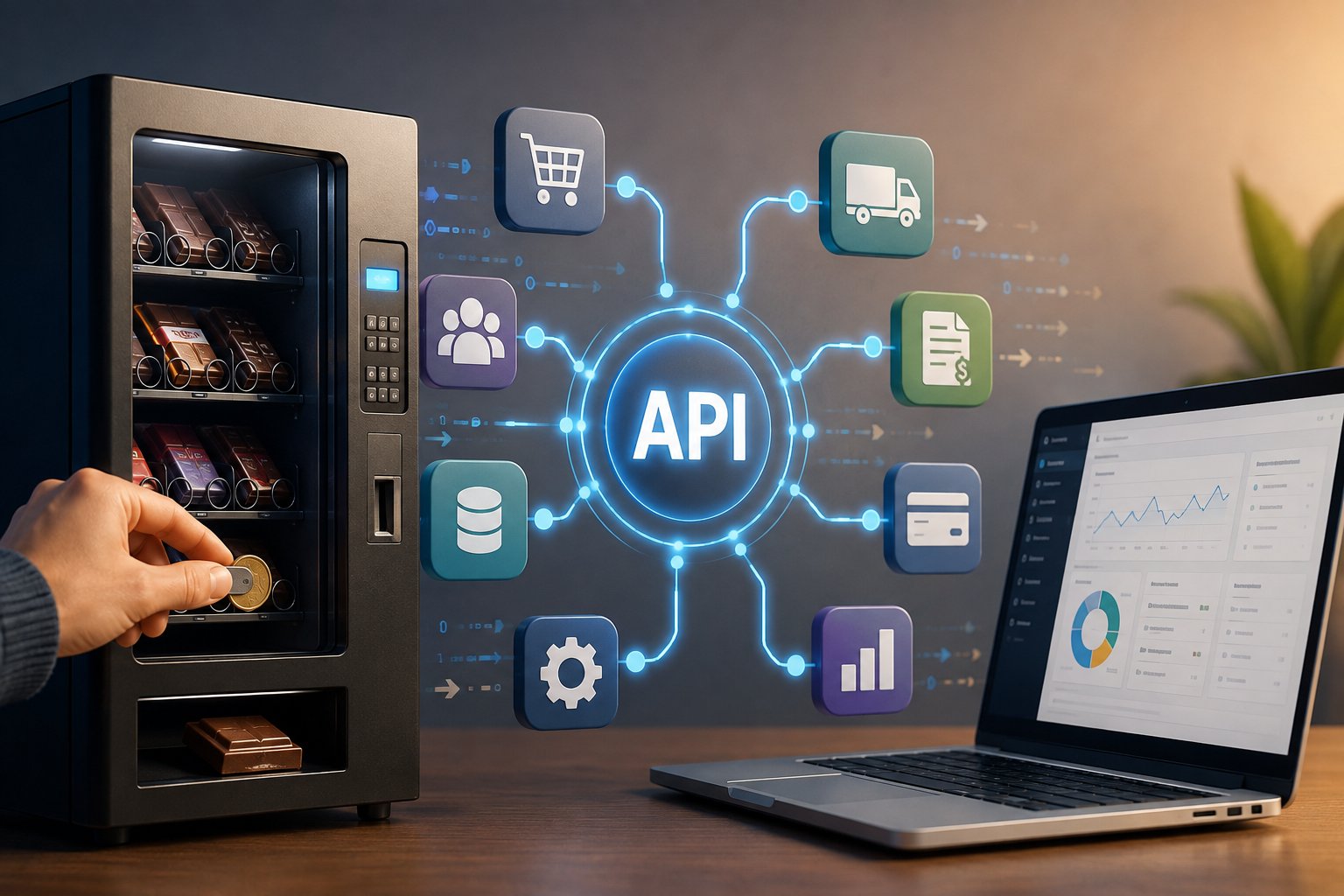
The easiest way to grasp it is to think of a chocolate vending machine. You put in your coins, out comes the chocolate. What exactly happens inside the machine in the meantime? We have no idea—and honestly, we don’t care, as long as the chocolate ends up in our hands. An API works exactly the same way: you don’t need to understand the other system’s inner machinery to be able to use it.
Endpoint and Call—the Slot and the Coin
Two terms, neither of which is anything to be afraid of:
API endpoint: these are the web addresses (URLs) that make one specific operation available—one for fetching statistics, say, another for creating a new item. Think of them as the coin slot on the machine.
API call: this is the moment we request or send data to an endpoint—in other words, when we drop in the coin. Something happens inside, and we get a response back: a confirmation (“done”), the data we asked for (“here you go”), or the very thing we’re after—the chocolate.
What’s It Good For in Practice?
APIs are what allow software built on completely different logic to exchange data quickly, efficiently, and securely—without either side knowing anything about the other.
Over the years we’ve built plenty of these connections with external systems, and countless third-party developers have created integrations for WordPress’s own API as well. The most common example is product synchronization, but when you generate a shipping label from your favorite courier inside your webshop, that’s one of these calls too. It’s how your shop talks to your invoicing software, your ERP, and even your card-payment providers.
Without it, every single shipping label, invoice, and product would have to be entered by hand. And there simply aren’t enough interns in the world to get through that—and even if there were, they’d all quit by day two.
Why We Love Using It
Our favorite part is that it spares our clients an enormous amount of manual work. That lets them work faster and more accurately, and focus on what really matters: making their business as successful as possible.
Which manual process is eating up huge chunks of your day? Tell us about it—and we’ll automate it.